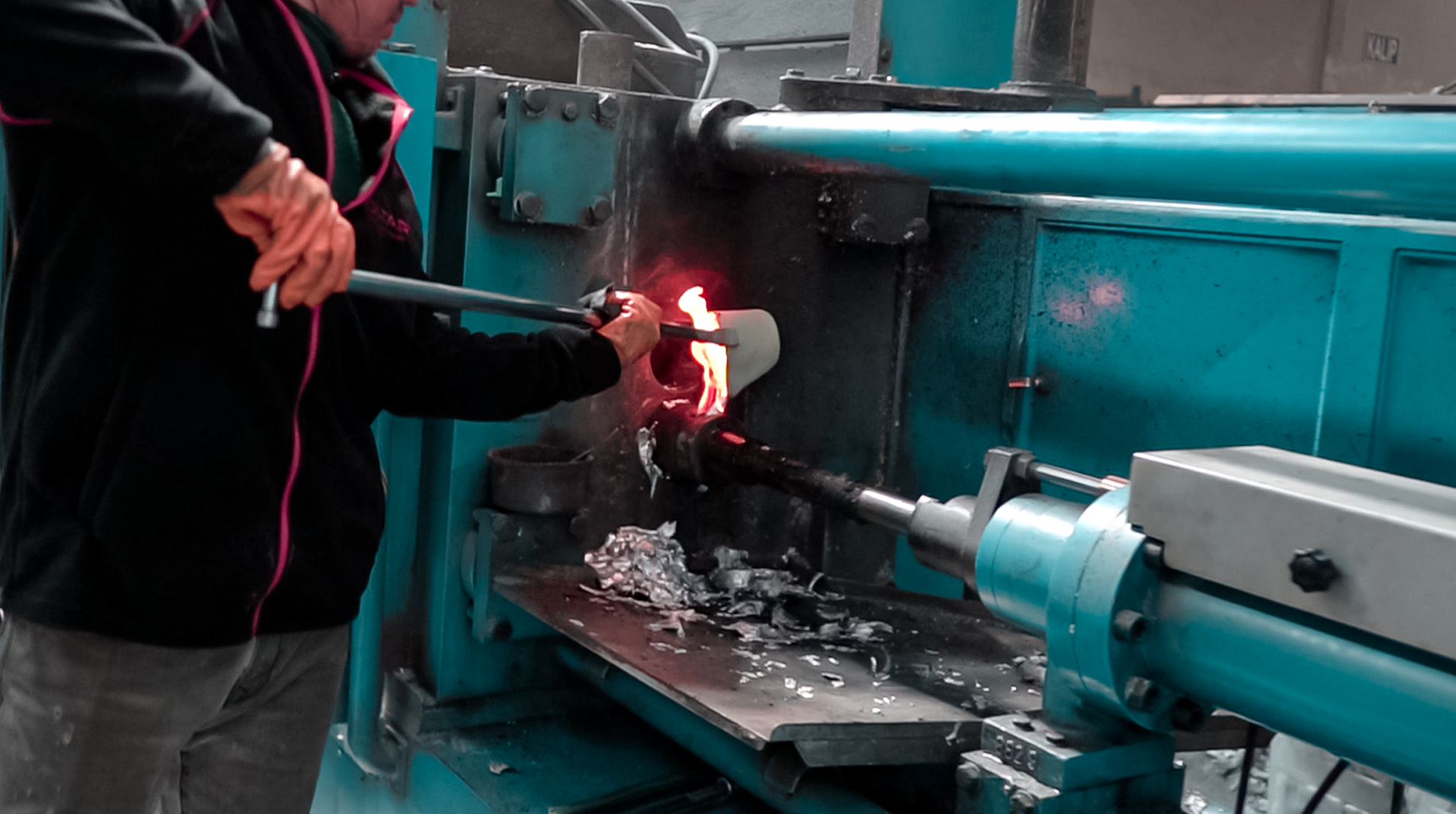
Injection Casting
Our high pressure injection molding method; It is based on the principle of filling the molten raw material into a metal mold under very high pressure. Thanks to the high pressure applied, large amounts of mold are filled very quickly. High pressure is continued until solidification is completed, and then the mold is opened and the part is removed from the mold with the help of push rods, and the process is completed.
Thanks to the high pressure injection molding method, it is possible to cast very complex shaped parts. Generally, the melting temperature of the materials to be poured with the high pressure injection molding method is below 800 ºC. High production rates can be achieved as the processes are carried out entirely by die casting machines. The pressure used is up to 400 bar. Machining is generally not required, thanks to its ability to work in a low tolerance range for the parts obtained as a result of high pressure injection molding.
In addition, the surfaces of the parts become fine-grained and durable as a result of rapid cooling. Since high pressure injection molds are expensive, this method is generally suitable if more than 5000 parts are to be produced.
If we look at the advantages of the high pressure casting system;
- First of all, complex shaped parts can be produced easily, and costs are reduced because rapid production takes place in the same mold and in multiple numbers.
- Thin-walled and sharp-edged parts can be produced easily as the molten material is filled into the mold by pressure.
- In high pressure casting, little or no surface treatment may be required.
- Since it is possible to pour material in thinner sections, material is saved.
- When aluminum and aluminum alloys are produced by high pressure casting method, they gain higher mechanical properties than the normal casting method.
- They have a wide range of castable parts.
